



Researchers have created a focused compound that blocks an enzyme linked to irritation in people with a genetic predisposition to Alzheimer’s disease, while still maintaining normal brain activity and successfully passing through the blood-brain barrier.
Scientists at the University of Southern California report that they have found new druglike compounds that could calm a major source of brain inflammation tied to Alzheimer’s disease. The study was just published in the Nature journal npj Drug Discovery.
Their target is “calcium-dependent phospholipase A2,” better known as cPLA2. The team zeroed in on this enzyme while studying people who carry the APOE4 gene, the strongest genetic risk factor for Alzheimer’s disease. Many APOE4 carriers never develop Alzheimer’s, but the researchers found that those with unusually high cPLA2 levels typically do, pointing to cPLA2 as a potential driver of harmful inflammation rather than a bystander.
A Delicate Therapeutic Challenge
Turning that insight into a treatment is tricky. cPLA2 is needed for normal brain activity, so a useful medicine would have to dial down the enzyme without shutting it off completely. It also has to reach its target, which means the molecule must be small enough to pass through the blood-brain barrier.
“In this study, we identified compounds that act selectively on cPLA2, with minimal effects on related PLA2 enzymes that are important for normal cellular function,” said senior author Hussein Yassine, director of the Center for Personalized Brain Health at the Keck School of Medicine of USC. “Across cell-based and animal models, cPLA2 activity was reduced at low concentrations, indicating that the compounds are potent in brain-relevant systems.”
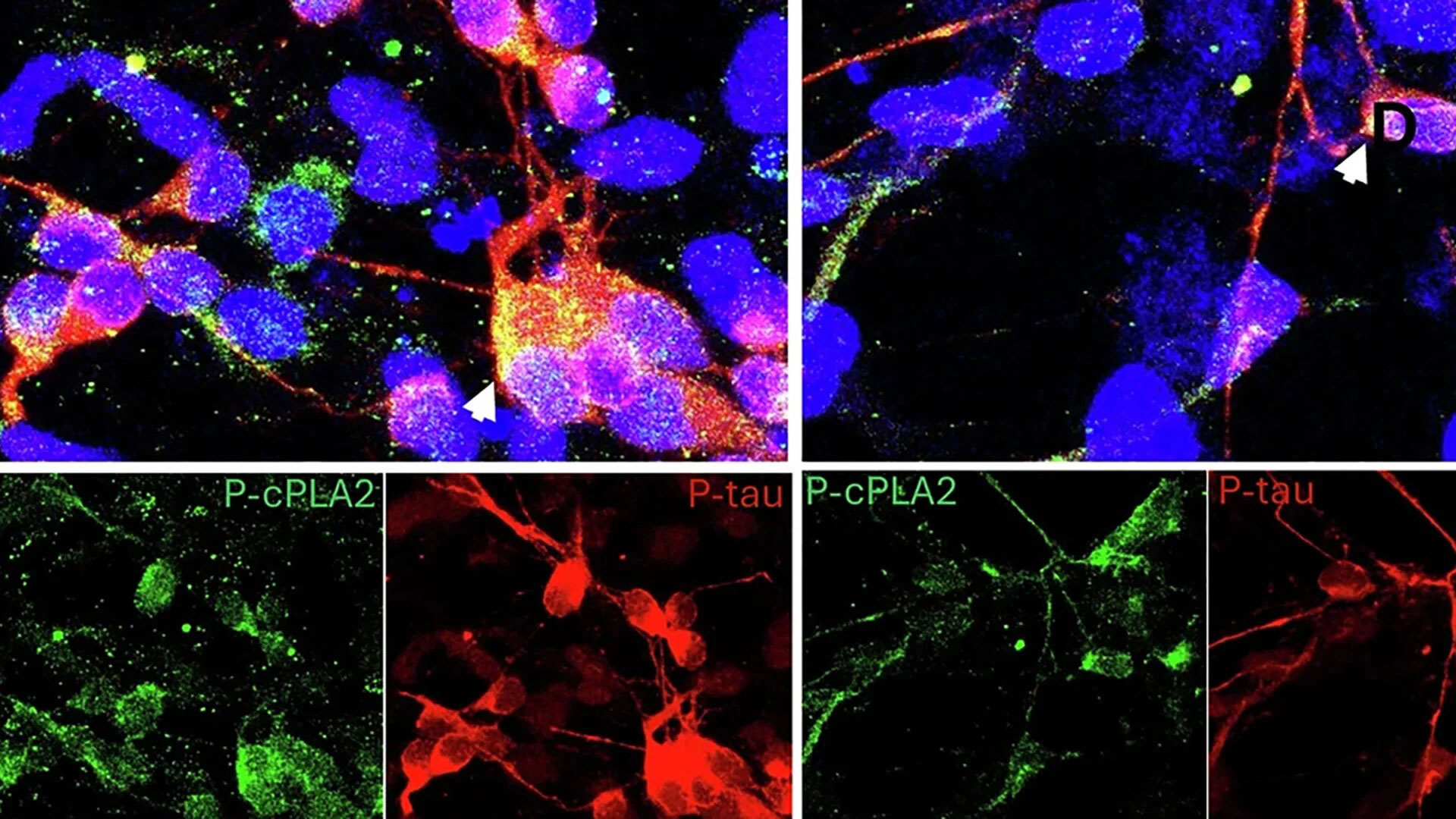
Alzheimer’s-linked brain inflammation: Evaluating molecules
To get there, the team leaned on high-powered computational screening to sift through billions of candidate molecules. They promoted the ones most likely to hit cPLA2 specifically, enter the brain, and work under realistic biological conditions. Vsevolod “Seva” Katritch of USC Dornsife and the USC Michelson Center for Convergent Bioscience developed the screening approach.
After the shortlist emerged, pharmacologist Stan Louie of the USC Alfred E. Mann School of Pharmacy and Pharmaceutical Sciences prepared the leading compounds for dosing in animal models and then measured how much of each one actually reached the brain.
Promising Results in Cells and Animal Models
A cPLA2 inhibitor that reduced pathological cPLA2 activation in human brain cells exposed to Alzheimer’s-related stressors became the prime candidate.
In mouse models, the inhibitor penetrated the blood-brain barrier and modulated neuroinflammatory pathways. The study suggests that inhibiting cPLA2 could be a promising therapeutic approach for neurodegenerative diseases.
“Our goal is to find out whether targeting inflammation can alter Alzheimer’s risk — particularly in APOE4 carriers,” Yassine said. “This next phase focuses not on promises, but on carefully determining whether modulating this pathway is safe, feasible, and ultimately meaningful for human disease.”
Reference: “Development of potent, selective cPLA2 inhibitors for targeting neuroinflammation in Alzheimer’s disease and other neurodegenerative disorders” by Anastasiia V. Sadybekov, Marlon Vincent Duro, Shaowei Wang, Brandon Ebright, Dante Dikeman, Cristelle Hugo, Bilal Ersen Kerman, Qiu-Lan Ma, Antonina L. Nazarova, Arman A. Sadybekov, Isaac Asante, Stan G. Louie, Vsevolod Katritch and Hussein N. Yassine, 7 January 2026, npj Drug Discovery.
DOI: 10.1038/s44386-025-00035-0
The research was supported with grants from the National Institute on Aging (U01AG094622, RF1AG076124, R01AG055770, R01AG067063, R01AG054434, R21AG056518, and P30AG066530); the National Institute of General Medical Sciences (R01GM147537); Department of Defense (W81XWH2110740), the Alzheimer’s Drug Discovery Foundation (GC-201711–2014197); USC CTSI KL2 (UL1 TR000004); and donations from the Vranos and Tiny Foundations and Lynne Nauss.
Disclosure: Yassine, Katritch and Louie are the founders of PeBRx, which is developing cPLA2 inhibitors. No other authors have any competing interests.
Never miss a breakthrough: Join the SciTechDaily newsletter.
Follow us on Google and Google News.